

You finally settled your workers’ compensation case. The medical treatment ended, your permanency award was paid, and you tried to move forward with your life. Then something changed. Your back pain became unbearable. Your knee started giving out. Your shoulder that once only bothered you occasionally now keeps you awake every night. Your doctor orders a new MRI and tells you something you never expected:
“You now need surgery.”
One of the first questions we hear from injured workers is:
“My workers’ compensation case is already over. Is there anything I can do?”
The answer surprises many people.
Possibly, yes.
Many New Jersey workers’ compensation claims can be reopened when a work-related injury substantially worsens after the original settlement or award.
That means you may still be entitled to:
- Additional authorized medical treatment
- Temporary disability (lost wage) benefits
- Additional permanent disability compensation
However, strict legal deadlines apply, making it important to have your case reviewed as soon as possible.
Why Do Workers’ Compensation Injuries Get Worse?
Many injured workers assume that once treatment ends, their injury should remain stable.
Unfortunately, that is not how many orthopedic injuries behave.
In fact, some workplace injuries continue to deteriorate for years.
This happens because of:
- Progressive arthritis
- Degenerative disc disease
- Scar tissue formation
- Cartilage loss
- Joint instability
- Continued wear and tear
- Nerve compression
Someone who originally improved with physical therapy may eventually require injections.
Someone who received injections may later require surgery.
Someone who underwent surgery may eventually need another surgery years later.
That is exactly why New Jersey law recognizes that certain workers’ compensation claims deserve another look.
Common Injuries That Frequently Worsen After a Workers’ Compensation Settlement
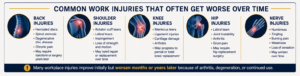
While almost any injury can worsen, certain injuries are far more likely to require additional treatment years later.
Back Injuries
Lumbar and cervical spine injuries are among the most common claims that later require reopening.
Workers often begin with conservative treatment, including:
- Physical therapy
- Chiropractic care
- Anti-inflammatory medication
- Epidural steroid injections
Over time, however, MRI studies may show worsening disc herniations, spinal stenosis, or nerve compression.
Many injured workers eventually require:
- Additional epidural injections
- Radiofrequency ablation
- Microdiscectomy
- Lumbar decompression
- Lumbar fusion
- Cervical fusion
Knee Injuries
A torn meniscus may initially respond well to surgery or therapy.
Unfortunately, the injury often accelerates arthritis within the joint.
Years later, many workers develop:
- Chronic swelling
- Locking
- Instability
- Loss of motion
- Progressive arthritis
Some ultimately require:
- Additional arthroscopic surgery
- Cartilage restoration procedures
- Partial knee replacement
- Total knee replacement
Shoulder Injuries
Shoulder injuries rarely improve without ongoing consequences.
Rotator cuff tears frequently enlarge over time.
Labral tears often become increasingly painful with continued use.
Many injured workers eventually require:
- Arthroscopic rotator cuff repair
- Biceps tenodesis
- Shoulder decompression
- Shoulder replacement surgery
Even after surgery, permanent weakness and loss of range of motion frequently remain.
Neck Injuries
Cervical injuries often become progressively symptomatic.
Workers may develop:
- Tingling into the arms
- Numbness
- Weakness
- Loss of grip strength
- Headaches
- Cervical radiculopathy
When conservative treatment fails, cervical spine surgery sometimes becomes necessary.
Hip Injuries
Hip injuries frequently worsen because every step places additional stress on the joint.
Workers often experience:
- Groin pain
- Clicking
- Limited motion
- Arthritis
Some eventually require hip replacement surgery years after their original workers’ compensation case ended.
Nerve Injuries
Nerve damage can progressively worsen even after treatment has concluded.
Workers may develop:
- Burning pain
- Muscle weakness
- Muscle atrophy
- Loss of sensation
- Reduced grip strength
- Difficulty walking
These changes often require updated neurological testing, including EMG studies.
Does Your Injury Sound Familiar?
If your condition has become significantly worse since your workers’ compensation case was resolved, you should not assume that you have lost your rights.
The next question becomes whether New Jersey law allows your claim to be reopened and what evidence you will need to prove it.
How Does New Jersey Law Allow You to Reopen a Workers’ Compensation Claim?
After learning that your injury has worsened, the next question is:
“Does New Jersey law actually allow me to reopen my case?”
In many situations, the answer is yes.
New Jersey recognizes that some workplace injuries continue to deteriorate over time. Because of that, the Workers’ Compensation Act allows injured employees to ask the court to review a prior award when their disability has increased.
Under N.J.S.A. 34:15-27, an injured worker may file an Application for Review or Modification of Formal Award based upon an increase in disability resulting from the original work-related injury.
This law protects workers whose medical conditions substantially worsen after their original workers’ compensation case has concluded.
What Must You Prove?
You generally must show:
✅ Your medical condition has objectively worsened.
✅ The worsening is related to the original workplace injury.
✅ Your disability is greater than when your original award was entered.
✅ Medical evidence supports the increase in disability.
Simply saying your pain is worse is usually not enough.
What Medical Evidence Helps Reopener Claims?
One of the biggest mistakes injured workers make is assuming their subjective complaints will be enough.
While your symptoms are important, judges also look for objective medical evidence demonstrating that your condition has deteriorated. Typically, in most cases, we will seek a re-evaluation with the prior authorized treater.
Helpful evidence often includes:
- Updated MRI studies
- CT scans
- EMG/Nerve Conduction Studies
- X-rays showing worsening arthritis
- Surgical recommendations
- Operative reports
- Physical examination findings
- Permanent work restrictions
- Functional Capacity Evaluations (FCE)
- Opinions from your treating physicians or qualified medical experts
The stronger your medical documentation, the stronger your claim.
The Two-Year Deadline to Reopen Your Claim
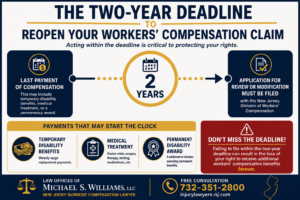
Payments That May Start the Clock:
✔ Temporary Disability Benefits
✔ Authorized Medical Treatment
✔ Permanent Disability Award
Missing the filing deadline may permanently prevent you from seeking additional workers’ compensation benefits.
Don’t Miss the Two-Year Deadline
Many workers wait until their pain becomes unbearable before contacting an attorney.
Unfortunately, waiting can be a costly mistake.
In most cases, an application to reopen a claim must be filed within two years of the last payment of compensation.
That payment may include:
- Temporary disability benefits
- Medical treatment paid by the workers’ compensation carrier
- A permanency award
Determining exactly when the deadline expires can sometimes be complicated. Depending on the circumstances, the date of the “last payment of compensation” may not be as obvious as many people assume.
Because missing this deadline can permanently bar additional benefits, it is important to speak with an experienced workers’ compensation attorney as soon as your condition worsens.
Order Approving Settlement vs. Section 20 Settlement
One of the most important questions we ask every new client is:
“How did your original workers’ compensation case end?”
The answer often determines whether your claim can be reopened.
| Order Approving Settlement | Section 20 Settlement |
|---|---|
| ✅ Most common | ❌ Usually final |
| ✅ Can be reopened | ❌ Generally cannot be reopened |
| ✅ Medical and temporary disability benefits may be available | ❌ Claim dismissed with prejudice |
| ✅ Additional permanency benefits may be available | ❌ Very limited exceptions-fraud |
The type of settlement that resolved your workers’ compensation case is often one of the most important factors in determining whether you may seek additional benefits.
Order Approving Settlement
Most New Jersey workers’ compensation claims conclude with an Order Approving Settlement.
If timely filed, a workers’ comp case resolved by way of an order approving settlement can be reopened.
Section 20 Settlement
A Section 20 Settlement is different.
These settlements generally resolve disputed claims by dismissing the case with prejudice, meaning the claim is usually final.
Because of that, Section 20 settlements generally cannot be reopened, even if your condition later becomes significantly worse.
If you are unsure which type of settlement resolved your case, an attorney can review your court documents and explain your options.
Additional Benefits You May Be Entitled To
Reopening a claim may allow you to recover benefits beyond those awarded in your original case.
These may include:
Additional Medical Treatment
The workers’ compensation carrier may be responsible for authorizing:
- Updated MRI studies
- CT scans
- Physical therapy
- Pain management
- Epidural injections
- Orthopedic consultations
- Neurosurgical evaluations
- Prescription medications
- Surgery
Temporary Disability Benefits
If additional treatment or surgery prevents you from working, you may also qualify for temporary disability benefits while you recover.
These weekly benefits can provide critical financial support during your recovery.
Additional Permanent Disability Compensation
If your permanent disability has increased since your original award, the Workers’ Compensation Court may award additional permanency benefits based upon the increased level of disability.
The amount depends on many factors, including the nature of your injury, your medical evidence, and the extent of the increased impairment.
Common Insurance Company Defenses
Workers’ compensation insurance carriers frequently challenge reopened claims.
Common arguments include:
❌ “Your condition is simply age-related.”
❌ “Nothing has objectively changed.”
❌ “Your current problems are unrelated to the workplace injury.”
❌ “Another accident caused your condition.”
❌ “You waited too long.”
❌ “Your disability has not significantly increased.”
These arguments can often be addressed with strong medical evidence and careful preparation.
Real-World Example
A warehouse employee injured his lower back while lifting heavy equipment.
After receiving physical therapy and epidural injections, his workers’ compensation case concluded through an Order Approving Settlement.
Several years later, his symptoms became significantly worse. He contacted our office within two (2) years of his last permanency payment and we filed to reopen his workers’ comp claim.
Following reopening the claim, we demanded that he be re-evaluated by the prior authorized treater.
The treater prescribed an updated MRI which revealed worsening of his disc herniations, and recommended a lumbar fusion surgery.
Surgery was authorized and during recover he was unable to work his current job with a subsequent new employer. This entitled him to temporary disability benefits.
Treatment concluded and he received additional permanent disability benefits for the increased permanent disability benefits.
Every case is unique. All claims depends on the specific facts, medical evidence, and applicable deadlines.
Frequently Asked Questions About Reopening a New Jersey Workers’ Compensation Claim
Should I reopen my workers’ compensation case if I now need surgery?
Yes. One of the most common reasons injured workers seek to reopen a claim is because they feel they may need surgery months or even years after the original case concluded.
For example, a worker who previously treated with physical therapy and injections may later require:
- Lumbar fusion
- Cervical fusion
- Rotator cuff repair
- Knee replacement
- Hip replacement
If the surgery is related to the original work injury and your disability has substantially worsened, you should seek additional benefits.
What if my injury became worse several years after my case ended?
Many work injuries do not worsen immediately.
Arthritis, scar tissue, degeneration, and continued use often cause an injury to become more disabling over time.
That is one of the reasons New Jersey law allows certain workers’ compensation awards to be reviewed after they have been entered.
However, filing deadlines still apply, making it important to have your case reviewed promptly.
Can I receive another permanent disability award?
Yes.
If the Workers’ Compensation Court determines that your permanent disability has increased since your original award, you may receive additional permanent disability compensation.
The amount depends upon numerous factors, including:
- The body part injured
- Medical findings
- Functional limitations
- Surgical treatment
- Permanent restrictions
- Overall increase in disability
Every case is different. An attorney experienced in workers’ compensation can help guide you.
Can I receive additional medical treatment?
Yes.
If your claim qualifies, the workers’ compensation carrier may be required to authorize additional treatment, including:
- MRI studies
- CT scans
- EMG testing
- Physical therapy
- Pain management
- Prescription medications
- Orthopedic consultations
- Neurosurgical evaluations
- Surgery
Can I receive temporary disability benefits again?
Possibly.
If authorized treatment or surgery prevents you from working, you may qualify for temporary disability benefits while you recover.
Whether those benefits are available depends on the facts of your case and applicable workers’ compensation law.
What if I don’t know how my case settled?
Don’t worry.
Many people have no idea whether their workers’ compensation case concluded through an Order Approving Settlement or a Section 20 Settlement.
An experienced attorney can review your court documents and explain whether reopening your claim may still be possible.
Common Mistakes That Can Hurt Your Claim
Many injured workers unintentionally jeopardize their ability to seek additional benefits.
Avoid these common mistakes:
Waiting Too Long
The biggest mistake is assuming you can always reopen your claim later.
Waiting until the deadline has expired may permanently affect your ability to seek additional benefits.
Ignoring New Symptoms
Don’t assume worsening pain is simply “part of getting older.”
New numbness, weakness, instability, or loss of function may indicate that your work injury has significantly progressed.
Paying for Treatment Without Legal Advice
Some workers begin treatment through private insurance without first determining whether workers’ compensation should be responsible.
Every situation is different, and understanding your rights early can make a significant difference.
Assuming the Insurance Company Is Correct
It is not uncommon for an insurance carrier to argue that your worsening condition is unrelated to your workplace injury.
That does not necessarily mean they are right.
Medical evidence, imaging studies, and expert opinions often determine whether a claim can proceed.
Why Experience Matters
Reopening a workers’ compensation claim is often more complex than filing the original claim.
Medical records must be reviewed carefully.
Prior settlements must be analyzed.
Updated diagnostic testing may be necessary.
Strict statutory deadlines must be met.
Insurance companies frequently dispute whether the worsening condition is related to the original injury.
An attorney experienced in New Jersey workers’ compensation law can help evaluate these issues and determine whether reopening your claim is appropriate.
Serving Injured Workers Throughout New Jersey
The Law Offices of Michael S. Williams, LLC proudly represents injured workers throughout New Jersey, including:
- Monmouth County
- Middlesex County
- Ocean County
- Mercer County
- Union County
- Essex County
- Somerset County
- Burlington County
- Monmouth Park and Jersey Shore communities
- Throughout the State of New Jersey
Whether your injury occurred in construction, healthcare, transportation, warehousing, manufacturing, retail, or another occupation, our office is prepared to evaluate your case.
Why Choose the Law Offices of Michael S. Williams, LLC?
When your injury has worsened, experience matters.
Clients choose our office because we focus on helping injured workers navigate the New Jersey workers’ compensation system.
We work to help clients pursue:
✔ Additional medical treatment
✔ Temporary disability benefits
✔ Increased permanent disability awards
✔ Fair resolution of disputed claims
Every case is evaluated individually, and we take the time to understand each client’s medical history, treatment, and legal options.
Don’t Assume Your Case Is Over
One of the most common misconceptions is that once a workers’ compensation case ends, there is nothing more that can be done.
In many cases, that simply isn’t true.
If your condition has worsened after an Order Approving Settlement, you may still have the right to pursue additional benefits.
The sooner your case is reviewed, the more options you may have.
Schedule Your Free Consultation Today
If your work-related injury has worsened after your workers’ compensation case was closed, let us review your situation and explain your legal options.
Our office proudly represents injured workers throughout New Jersey.
Law Offices of Michael S. Williams, LLC
Your Injury Has Changed. Your Benefits May Be Able to Change Too.
📞 Call 732-351-2800
Free Consultation
No Fee Unless We Recover Benefits for You
Practice Areas
Personal Injury
Car Accidents
Slip and Falls
Workers’ Compensation
Estate Planning
Corporate, Contracts & Business Development
Legal Disclaimer
This blog is provided by the Law Offices of Michael S. Williams for informational purposes only and does not constitute legal advice. Reading this article does not create an attorney-client relationship. Every personal injury case is unique, and outcomes depend on the specific facts and applicable law. You should not act or refrain from acting based on the information contained in this blog without first consulting a qualified attorney licensed in New Jersey.