What Happens if a Workers’ Compensation Doctor Sends You Back to Work Too Soon?
By the Law Offices of Michael S. Williams, LLC
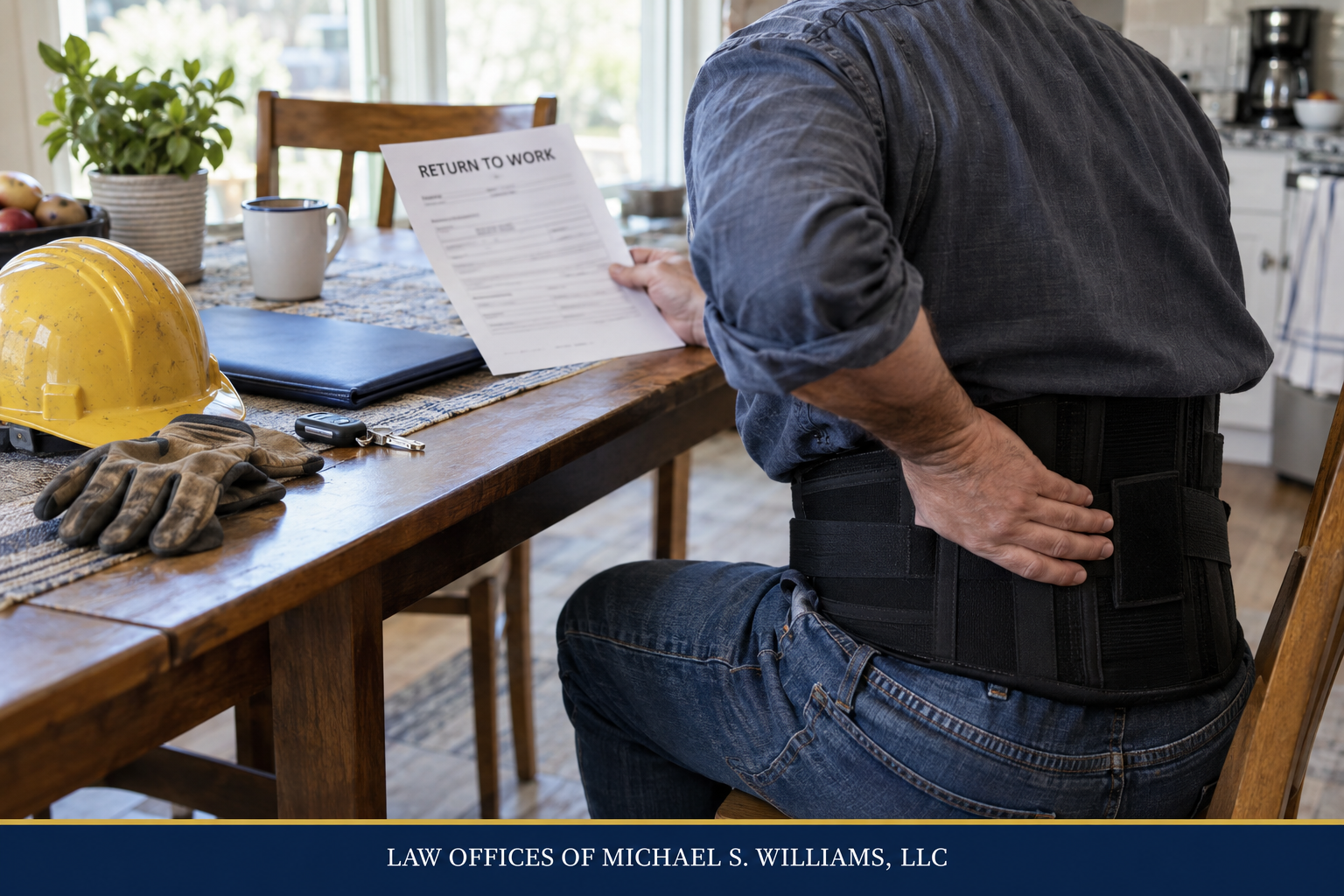
After a workplace injury, an authorized workers’ compensation doctor may release you to return to work even though you are still experiencing pain, weakness, limited movement or other significant symptoms.
The doctor may return you to full duty without restrictions. In other cases, the doctor may recommend light duty but impose restrictions that do not realistically account for the physical demands of your job.
A return-to-work release can affect both your health and your right to temporary disability benefits. You should not simply ignore the doctor’s instructions or refuse to report to work without obtaining legal advice. However, you also should not assume that the authorized doctor’s decision cannot be questioned.
An injured worker should consult an experienced New Jersey workers’ compensation attorney as soon as possible after a workplace injury—not only after a return-to-work dispute develops. Early representation allows an attorney to monitor medical treatment, confirm that all injuries have been reported, review work restrictions and address problems before treatment or temporary disability benefits are terminated.
Who Decides When You Can Return to Work?
In a New Jersey workers’ compensation case, the employer or its insurance carrier generally has the right to select the authorized medical providers.
The authorized treating doctor normally determines whether an injured employee:
• Remains unable to work
• Can return with temporary restrictions
• Can resume full-duty employment
• Requires additional medical treatment
• Has reached maximum medical improvement
Because the employer or insurance carrier selected the authorized doctor, that physician’s work-status determination often controls whether the carrier continues paying temporary disability benefits.
That does not mean the doctor’s opinion is always correct or that an injured employee has no way to challenge it.
A return-to-work decision may be disputed when the physician did not fully understand the employee’s job duties, failed to evaluate all injured body parts, overlooked significant symptoms or released the employee before recommended testing or treatment was completed.
What Is the Difference Between Full Duty and Light Duty?
A full-duty release generally means that the authorized doctor believes the employee can resume the regular job without medical restrictions.
A light-duty release permits the employee to return with specific physical limitations. Depending on the injury, those restrictions may include:
• No lifting over a specified weight
• No repetitive bending or twisting
• Limited standing or walking
• No climbing ladders or stairs
• No overhead work
• No kneeling or squatting
• Limited use of an injured arm, hand, leg or foot
• Seated work only
• Reduced working hours
• Additional rest periods
Restrictions should be clear enough for the employer and employee to understand what work can safely be performed. Vague restrictions such as “light duty as tolerated” can create disputes, especially when the doctor does not understand the actual physical requirements of the employee’s position.
What if You Do Not Believe You Can Perform Your Regular Job?
Tell the authorized doctor exactly what your job requires.
Do not merely state that your job is “physical” or that it involves “heavy work.” Explain the specific activities you must perform during a normal shift, including:
• How much weight you lift or carry
• How often you bend, twist, reach, push or pull
• How long you must stand or walk
• Whether you climb ladders or stairs
• Whether you operate machinery or drive
• Whether you must restrain, transfer or assist other people
• Whether the job requires repetitive movements
• Whether you work at heights or in hazardous conditions
• Whether your employer can realistically provide modified work
If possible, provide the doctor with a written job description. However, a generic job description may not accurately reflect the work you actually perform. Make sure the doctor understands the real physical demands of your position.
You should also describe your continuing symptoms and limitations accurately. Explain which movements increase your pain, what activities you cannot perform and whether you have experienced weakness, numbness, instability or other symptoms that could make returning unsafe.
Should You Refuse to Return to Work?
You should not simply disregard an authorized doctor’s return-to-work release or decide on your own to remain home.
Failing to report to work could impact your workers’ comp benefits and the employer may also claim that you abandoned your job, refused suitable work or violated an employment policy.
Instead, promptly contact a workers’ compensation attorney and document the situation.
Depending upon the circumstances, appropriate steps may include:
• Asking the authorized doctor to reconsider or clarify the work release
• Providing the doctor with a more accurate description of your job duties
• Requesting written restrictions
• Asking the employer to identify the work it expects you to perform
• Obtaining a written description of any proposed light-duty position
• Documenting continuing symptoms and physical limitations
• Requesting evaluation by another physician
• Seeking additional medical treatment
• Filing an application with the Workers’ Compensation Court when appropriate
The correct response depends upon the medical evidence, the proposed work and the circumstances of the individual claim.
What if Your Employer Offers Light-Duty Work?
If an authorized doctor releases you to light duty, your employer may offer modified work that it contends falls within the restrictions.
Before returning, try to obtain:
• The job title and expected duties
• The scheduled hours
• The physical activities required
• Any lifting, standing, walking or repetitive-motion requirements
• The rate of pay
• The anticipated duration of the assignment
• Confirmation that the employer received the doctor’s restrictions
A light-duty label does not automatically mean that the position complies with your medical restrictions. The actual duties matter.
If the employer asks you to perform work outside the restrictions, notify a supervisor promptly and document what occurred. Do not exaggerate your limitations, but do not conceal significant symptoms or perform unsafe activities merely because you are worried about losing your job.
Contact your attorney so the light-duty assignment and medical restrictions can be reviewed.
What if Your Employer Cannot Accommodate the Restrictions?
A doctor may release an employee to light duty, but the employer may not have suitable modified work available.
If the employer cannot provide work within the authorized restrictions, the employee would likely remain eligible for temporary disability benefits.
The employer or insurance carrier should not treat a restricted release as an unrestricted return to work when no appropriate light-duty position is actually available.
Document:
• When the release was issued
• When it was provided to the employer
• Who received it
• Whether the employer offered modified work
• The duties and hours of any offered position
• Whether the employer instructed you to remain home
• All communications concerning your return
Written documentation can become particularly important if the carrier later disputes responsibility for temporary disability benefits.
What if You Return to Work but Cannot Physically Continue?
An injured employee may attempt to return but discover that continuing symptoms make the work physically impossible.
If that happens, immediately report the problem to your supervisor and the authorized medical provider. Explain what activities caused difficulty and identify the symptoms you experienced.
Do not simply stop reporting to work without notifying the employer or seeking medical guidance.
Keep a record of:
• The date and time of the attempted return
• The duties you performed
• How long you worked
• The symptoms that developed or worsened
• Any request for assistance or modified work
• The names of supervisors or coworkers who observed the problem
• Whether the employer sent you home
• Whether you contacted the authorized doctor
An unsuccessful return-to-work attempt may be important evidence that the release was premature or that different restrictions are necessary.
Can Temporary Disability Benefits Stop When You Are Released to Work?
A return-to-work release can cause the insurance carrier to terminate temporary disability benefits.
New Jersey temporary disability benefits generally provide 70% of an injured employee’s average weekly wage, subject to the statutory minimum and maximum rates. Eligibility depends upon the employee’s inability to work because of a compensable workplace injury and the applicable medical evidence.
Disputes may arise when:
• The doctor releases the employee before treatment is completed
• The employee is released to light duty but the employer has no suitable work
• The proposed job exceeds the medical restrictions
• The employee attempts to return but cannot continue
• The carrier stops benefits based on an examination by a different physician
• The authorized doctor fails to address all work-related injuries
• The employee returns for fewer hours or substantially reduced wages
When an employee returns to reduced hours or lower-paying work because of a workplace injury, there may also be an issue concerning temporary partial disability benefits. The calculation and availability of those benefits depend upon the facts, wage information and medical restrictions. However, while on light duty an employee is still typically entitled to 70% of their average weekly wage, subject statutory rates. Thus, an employee who returns to work in a limited capacity may also receive workers’ compensation temporary disability benefits in an offset amount.
An attorney can review whether benefits were properly stopped, whether additional payments may be owed and whether court intervention is appropriate.
Can You Ask for Another Medical Opinion?
An injured employee may request another evaluation when there is a legitimate disagreement concerning the employee’s ability to return to work.
The insurance carrier is not necessarily required to authorize a second opinion voluntarily. However, an attorney can evaluate whether additional medical evidence should be obtained and whether the matter should be presented to the Workers’ Compensation Court.
A second evaluation may be especially important when:
• The authorized doctor does not understand the job requirements
• Significant symptoms remain unresolved
• Diagnostic testing shows an injury that has not been adequately addressed
• Another authorized doctor recommended additional treatment
• The employee has not completed recommended therapy, injections or surgery
• The doctor releases the employee without evaluating all injured body parts
• The employee unsuccessfully attempts to return to work
Learn more about medical-provider issues in our article: Can You Choose Your Own Doctor in a New Jersey Workers’ Compensation Case?
What if the Doctor Declares You at Maximum Medical Improvement?
Maximum medical improvement, commonly called MMI, generally means the authorized physician believes additional treatment will not materially improve the work-related condition.
A finding of MMI will terminate both active medical treatment and temporary disability benefits. The case may then proceed toward an evaluation of permanent disability.
However, an MMI determination may be disputed when:
• Recommended treatment was never completed
• Necessary diagnostic testing was not performed
• An injured body part was never evaluated
• The employee’s condition continues to worsen
• Another physician recommended additional care
• The employee remains unable to perform the job
• The doctor’s conclusion is inconsistent with the medical records
An employee should promptly consult an attorney before accepting a premature discharge or MMI determination as final.
Can an Attorney Ask the Workers’ Compensation Court to Intervene?
When necessary treatment or temporary disability benefits are denied, an attorney can file a Motion for Medical and Temporary Benefits with the New Jersey Division of Workers’ Compensation.
Depending upon the evidence, the motion may request:
• Additional authorized medical treatment
• Evaluation by another physician
• Clarification or modification of work restrictions
• Reinstatement of temporary disability benefits
• Payment of unpaid temporary disability benefits
• Relief concerning a premature return-to-work release
A motion must be supported by appropriate medical and factual evidence. Filing a motion does not guarantee a particular result, but it provides a procedure for asking a Judge of Compensation to decide the dispute.
Additional information is available in our article: What Can You Do When Workers’ Compensation Refuses Treatment?
Why Should You Contact an Attorney Before a Problem Develops?
An injured worker should not wait until treatment is stopped, temporary disability benefits are terminated or a doctor issues an inappropriate return-to-work release before obtaining legal representation.
The employer and insurance carrier control authorized medical treatment in New Jersey. Important decisions are therefore made throughout the claim often before the employee realizes that a dispute exists.
Early legal representation can help ensure that:
• The accident is properly reported
• Every injured body part is documented
• The authorized doctor understands the employee’s actual job duties
• Work restrictions are clear and medically appropriate
• Temporary disability benefits are calculated correctly
• Treatment requests are not overlooked
• A premature discharge or return-to-work decision is addressed promptly
• Evidence is preserved before benefits are terminated
Even when the employer and insurance carrier initially appear cooperative, their interests are not the same as those of the injured employee.
You should have an attorney protecting your rights throughout the claim—not only after something goes wrong.
Speak With a New Jersey Workers’ Compensation Lawyer
If a workers’ compensation doctor has released you before you feel physically capable of returning to work, obtain legal advice promptly.
Do not ignore the release, remain home without explanation or attempt to resolve the dispute entirely on your own. A return-to-work decision can affect your medical treatment, temporary disability benefits, employment and the ultimate value of your workers’ compensation claim.
Attorney Michael S. Williams has represented injured New Jersey workers for nearly 20 years. The Law Offices of Michael S. Williams, LLC regularly handles claims involving:
• Premature return-to-work releases
• Inadequate light-duty restrictions
• Employers unable to provide restricted work
• Denied or delayed medical treatment
• Terminated temporary disability benefits
• Premature findings of maximum medical improvement
• Motions for Medical and Temporary Benefits
• Permanent partial and permanent total disability claims
Learn more about our workers’ compensation representation:
Monmouth County Workers’ Compensation Lawyer
Tinton Falls Workers’ Compensation Lawyer
Freehold Workers’ Compensation Lawyer
Call 732-351-2800 for a free consultation.
Our offices are located in Tinton Falls and New Brunswick. Telephone and virtual consultations are also available. There is no upfront attorney’s fee.
Practice Areas
Personal Injury
Car Accidents
Slip and Falls
Workers’ Compensation
Estate Planning
Corporate, Contracts & Business Development
Legal Disclaimer
This blog is provided by the Law Offices of Michael S. Williams for informational purposes only and does not constitute legal advice. Reading this article does not create an attorney-client relationship. Every workers’ compensation case is unique, and outcomes depend on the specific facts and applicable law. You should not act or refrain from acting based on the information contained in this blog without first consulting a qualified attorney licensed in New Jersey.